Emma Jin was never interested in working at a startup.
She only went to the third day of Carnegie Mellon University's job fair, the one for smaller companies, because she was available and hoped for some swag. When she saw someone holding a sign that just said "compilers," her interest was piqued. They didn’t pre-book an interview room, so an engineer from Semgrep (at the time called r2c) interviewed Emma at a nearby Starbucks. She recalls, "That was the most fun interview I've ever done."
At the time, Emma had another offer from a large tech company, and was hesitant to join Semgrep. "I wanted the [big company] name on my resume," she said. "I didn't really understand what a startup was other than tech bros and high-risk, high-reward and I didn't identify with either of those. But what I didn't realize was that a startup gives you more opportunities to grow, because the company is growing and there's always more need."
When Emma Jin (‘20) first saw r2c’s website (now Semgrep) in August 2019, she thought the company was a scam.
In the end, the work was too good a match to pass up, and even the recruiter at the other company urged her to accept Semgrep’s internship offer. Emma became the company’s first intern in summer 2020. Six years later, she’s still here. She was promoted to senior engineer two years after joining full-time, then to manager a year and a half after that.
Charissa Kim’s path looked different, but the hesitation was the same.
While studying computer science and legal studies at UC Berkeley, she had interned at Google and at the NSA, but never at a startup. At organizations that size, she found it hard to see the impact of her work. A startup promised the opposite, but also made her nervous. She was “willing to take that risk because it was just an internship. I had nothing to lose.”
Charissa joined as Semgrep’s first security intern in summer 2023. She was also weighing several other paths, including law school. Her manager, Jonathan Werrett, now Semgrep’s CISO, knew she didn’t want to be a full-time engineer, and suggested she try the Technical Program Manager (TPM) route. Charissa didn’t even know the role existed, but has since become Semgrep’s first TPM and has been enthusiastically building and owning Semgrep’s Governance, Risk, and Compliance (GRC) program ever since.
Interns ship to production
Once Emma and Charissa joined, they, like all Semgrep interns, were expected to ship.
For Drew Dennison, Semgrep’s CTO and co-founder, it’s always been important that interns get something to production by the end of the internship. He explained the first month is mentorship heavy, with most interns fixing bugs and getting small changes fixed in their initial few weeks. After that, the focus shifts to learning and working on projects. He believes that “the best ideas win. We want people to bring new knowledge and new technologies. A lot of fresh perspectives come from our interns.”
Former interns confirm that’s the experience they had.
Vivianna Lieu’s (Intern ‘25) project was in private beta by the end of her internship. “I was able to push it to production and go for it. I ran a technical enablement meeting, I wrote all the technical docs, I did all that fun stuff.” When comparing notes with friends at other companies, Vivianna noticed that interns elsewhere were given projects just to stay busy. She describes Semgrep as a “really fun group project” where things actually have to get done. It’s a good place to be “if you care about working and you care about learning a lot.”
Austin Theriault’s (Intern ‘22) project followed him in the years after his internship. Customers were asking for an IDE extension, and he raised his hand to take on the project. “It'll come up in a deal and people will ask ‘Austin, can you fix this one thing for us?’ even though I'm on a completely separate project.” Today, he’s the Tech Lead for Semgrep Guardian, which he calls version two of his original work. “If I was an intern now, this is probably what I would’ve chosen to do.”
Cooper Pierce (Intern ‘22) says that kind of customer exposure is hard to find at a big company. At a startup, “you get more experience understanding the nuances of what customers want. You’re going to be closer to the customer than you are at a really big tech company."
Dimitar Janevski’s (Intern ‘23) Semgrep internship was his first work experience in the United States. As a student from Canada, he believes it opened the doors to a lot of other opportunities. He was able to learn a lot from other engineers, most notably about the importance of letting users be the judge of your work. “This has personally helped me detach myself from specific ideas and features just because I like them or maybe they are technically interesting to build, and instead remain flexible to the users’ needs and prioritize their experience when making decisions.”
A front-row seat to how the business runs
Beyond working on their projects, interns also get a close look into how the business operates.
For Austin, one of the fun parts about being at Semgrep, both as an intern and an employee, is the opportunity to learn about how the business functions. “Semgrep is great because you can just walk over and ask someone your questions. You could talk to Tyler [Semgrep’s VP Finance] and he’ll tell you. But if you go work somewhere else, you can't just go find the Tyler at a big company and talk to them about company finances.”
Aimen Moten (Intern ‘24) called out the exposure to leaders. “Especially if you have never worked at a smaller company or startup, it is a rare chance to work closely with the CEO and CTO and see firsthand how a company actually works, not just the engineering slice you would get elsewhere.”
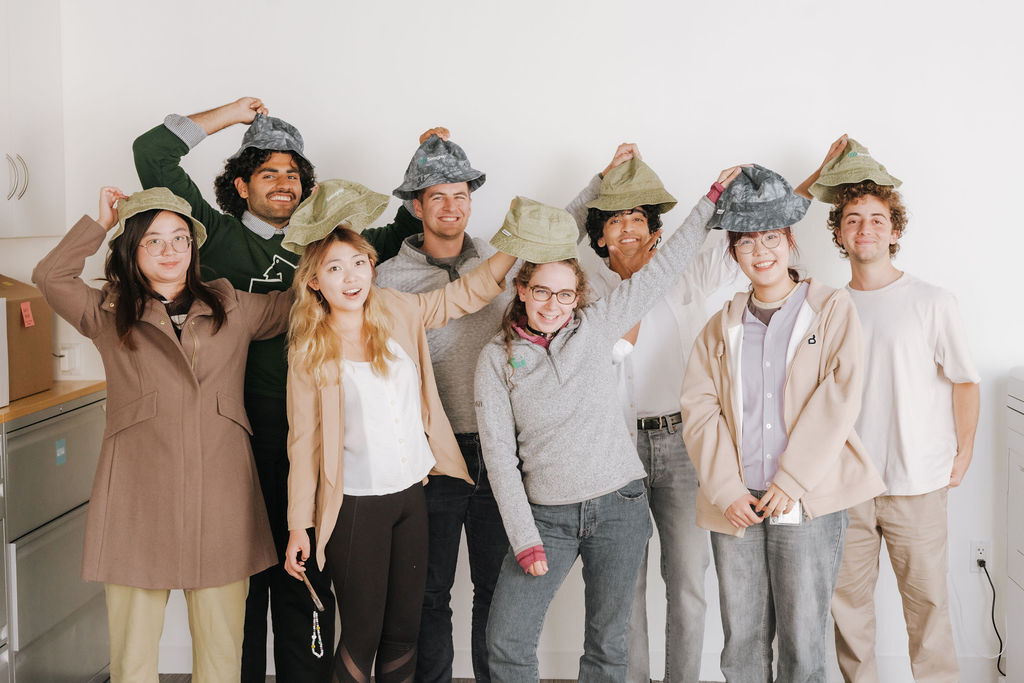
Summer 2023 interns with Semgrep CEO Isaac Evans (fourth from left) during Hub Week.
People who make time for you
Almost every intern brought up the people at Semgrep.
Vivianna remembers coworkers from other teams going out of their way to invite her to dinner and fill her in on the company. "People wanted to know what I thought." Dimitar had a similar observation, noting he felt comfortable asking for help and learning from anyone on the team, regardless of their seniority.
Some of those relationships outlasted the internship. Cooper and Ben, who both interned in summer 2022, ended up living together in San Francisco after they accepted return offers. Emma found that other similar aged coworkers became her support group, and she now encourages other interns and new grads to form one.
That's why many of them came back. Ben Kettle (Intern ‘22) returned full-time for nearly three years. “No matter where I go from here I will always strive to have as much fun with the people I work with as I did at Semgrep."
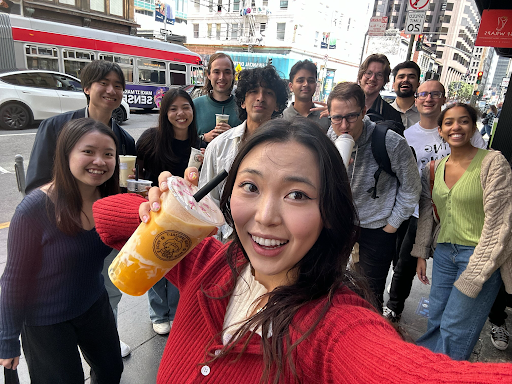
Summer 2025 interns and Semgrep employees on a boba run on the last day of the program. Seven of the 12 people in the photo were current or former interns.
Where are they now?
At Semgrep:
Emma (‘20) is an Engineering Manager, leading the Code and Guardian teams.
Austin (‘22) is the Tech Lead for Guardian.
Cooper (‘22) is a Senior Software Engineer, working on the Code and Secrets team.
Charissa (‘23) is a Security Technical Program Manager who helped build and now owns Semgrep’s GRC program.
Vivianna (‘25) is a Software Engineer on the Supply Chain team, focused on the malware incident response project.
Beyond Semgrep:
Ben (‘22) spent nearly three years at Semgrep before joining Tesla as a Senior Software Engineer, where he works on firmware for energy storage products.
Dimitar (‘23) is a Software Engineer on Tesla’s Autopilot team, building AI Tooling to support Tesla’s self-driving and Robotaxi programs.
Aimen (‘24) is a Software Engineer at Google, working on YouTube features that help creators and brands collaborate.
Is Semgrep the right fit for you?
Vivianna knows a startup internship isn't for everyone. Her friends at larger companies "get the whole intern cohort, there's like 50 of them, they all make friends, and every Friday they have some [organized] event. If that's what you're looking for in an internship, this is probably not the place to do it."
Semgrep's cohort is smaller, but you won't be left on your own. In summer 2027, interns will also have a calendar of structured events. In exchange for the big-company cohort, you get something harder to find. "If you want to feel really involved, if you want to feel like you're a contributing member," Vivianna says, "Semgrep is a really good place to do that.”
When asked for her advice about a startup internship, Charissa was quick to respond. “Just do it. A lot of people ponder the pros and cons of joining a startup, but just do it. You won't truly know unless you get the hands-on experience. If you like it, great. And if you don't, now you've tried it rather than just always thinking about it.”
Join us next summer
We’re still accepting applications for our summer 2027 engineering internships in San Francisco.