On October 21, six security incidents hit the industry in a single day, among them a certificate authority compromise, two remote code execution vulnerabilities, and a backdoored Python package. Days like this are why our customers use Semgrep, and they test how fast we can turn what we learn into the product. Here’s what we built in response.
The Advisories page now leads with active incidents. Semgrep Guardian, our security layer for AI coding agents, now checks for vulnerable runtimes and compromised extensions. And a new workflow finds exposed Node.js and PHP versions across your repositories.
In addition, Guardian is now self-serve and works with Codex and Claude Code. In all, we shipped more than 50 updates in October. This post is the first in a monthly series on what we're shipping.
Turning incidents into protections
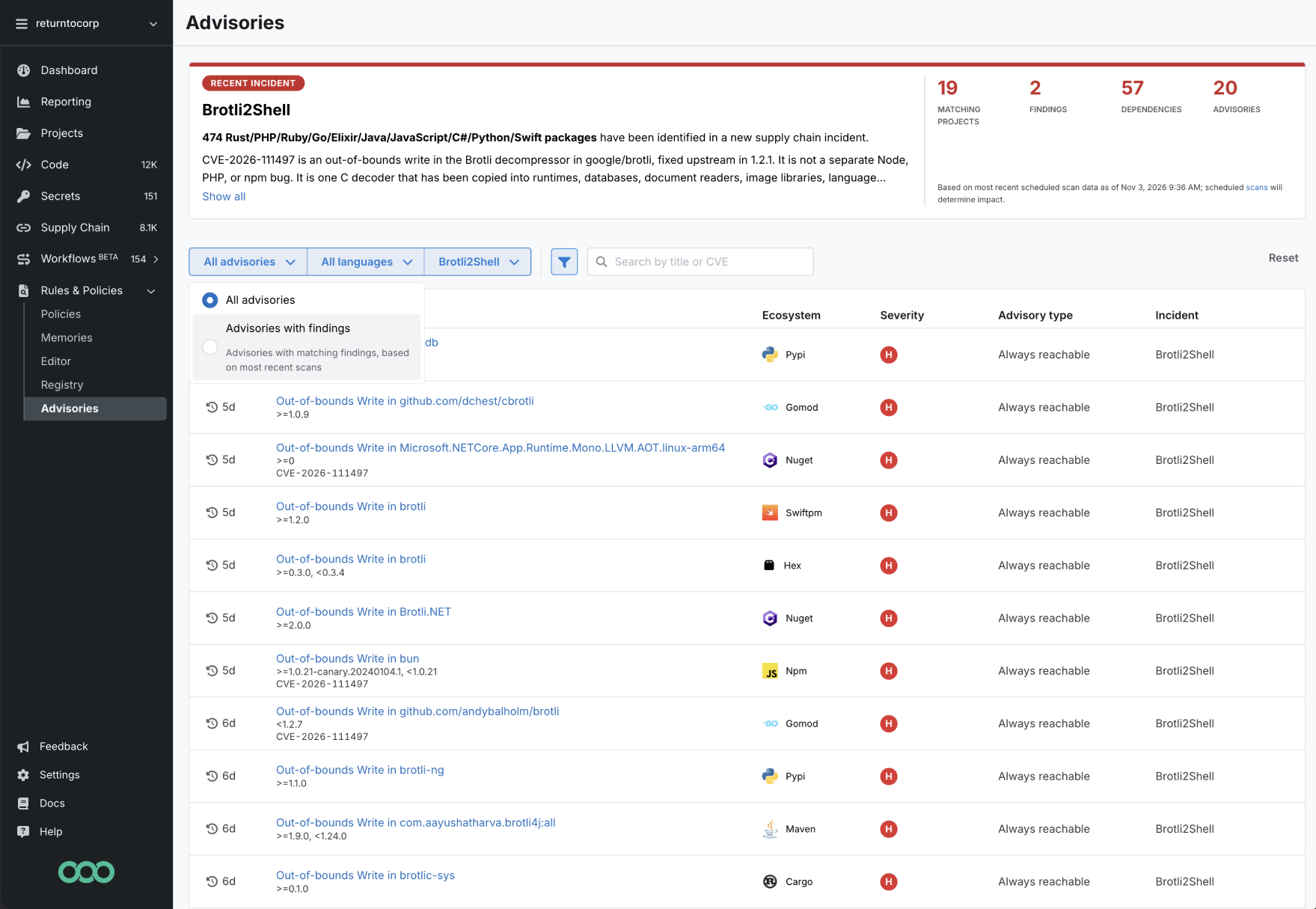
Incident-first Advisories. The Advisories page now leads with active incidents. Each incident card shows the matching projects, findings, dependencies, and advisories, so you can answer the first questions of any incident: are we affected, where, and what do we fix?
Zero in on advisories that matter. Filter advisories by language, severity, and advisory type, or show only advisories with findings in your projects.
Detect-2Shell workflow. This new workflow in Semgrep Agentic Workflows finds the Node.js and PHP versions referenced in Docker images, .nvmrc files, infrastructure as code, and CI. It marks each one as vulnerable, unpinned, fixed, or unknown, uses AI to check versions set in variables or base images, and tells you how to fix each risk.
Certificate trust updates. After the eMudhra certificate authority compromise, the Semgrep CLI and its container images now trust an updated set of certificate authorities. Semgrep Supply Chain added advisories for affected packages, such as certifi, uv, and pip. If you installed Semgrep with Homebrew, run brew update, then brew upgrade certifi ca-certificates.
Compromised extension check. Guardian now tells you if you're running a compromised version of the Claude Code extension for Cursor that contains an SSH backdoor.
Bun lockfiles. Supply Chain now parses bun.lock, so Bun projects get dependency, malware, and vulnerability coverage. See supported package managers.
Smarter Python inventory. Every package in requirements.txt, pinned or not, now appears in your dependency inventory and SBOM.
Vulnerable runtime checks. At the start of each session in Claude Code and Codex, Guardian checks your local PHP version and stops with an error if it's affected by PHP2Shell. It also warns you if your Node.js version is affected by Node2Shell. Both checks name the version to upgrade to, and you can turn each one off. See the Guardian FAQ.
Guardian goes self-serve
Start a free trial, no sales call needed. New Semgrep organizations can start a 30-day free trial of Guardian and upgrade in the product.
Guardian policies and developer rules, now generally available. Choose which Semgrep Code and Secrets rules Guardian runs from the Policies page, the same place you manage the rest of your detection. See Guardian rules and configuration.
Codex support. Guardian now supports Codex with the same capabilities as Claude Code. Scanning for code, dependencies, and secrets is automatic, and you don't need to install the Semgrep CLI. A new version for Copilot is currently in early access. Reach out to your account team to learn more.
PowerShell support. Guardian hooks run on PowerShell as well as Bash, which covers developers on Windows.
Scanning that never blocks your agent. Guardian scans in the background and hands results to your agent when they're ready. If the agent has already stopped, Guardian wakes it up to fix what it found.
Signed, automatic updates. Guardian updates itself as soon as we release a new version. Each download is verified to SLSA Level 3, so you can verify it came from our build pipeline.
Autofix for transitive dependencies. Most Supply Chain findings are in transitive dependencies. Autofix can now open a lockfile-only pull request for them in npm and PyPI projects, and it only opens one when the PR actually fixes the finding.
More controls, more flexibility
Choose your AI provider. AI provider settings now offer Automatic and Manual modes, Cloudflare Workers AI, and a direct connection to Anthropic with your own API key.
Scheduled Agentic Workflows, in public beta. Schedule Agentic Workflows to run daily, weekly, or monthly on the projects you choose. Scheduling requires Unified Policies, the default for new organizations.
Wiz on major source code managers. The Wiz integration now sends findings from Azure DevOps, Bitbucket Cloud, and Bitbucket Data Center repositories, as well as GitHub and GitLab. You don't need to change your Wiz configuration.
SCIM for single-tenant deployments. SCIM provisioning, in public beta, now supports single-tenant deployments. You can also choose primary admins that directory sync can't demote or remove.
Cursor Origin, in public beta. Connect Cursor Origin to run Managed Scans and see scan checks and finding comments in Cursor pull requests.
Private registries on AWS CodeArtifact. Supply Chain can resolve private Maven and Gradle packages from AWS CodeArtifact through an IAM role.
Tighter read-only access. Read-only users and API tokens can no longer change remediation policy automations or create tickets, which matches the documented read-only scope.
Memories from exceptions. When a reviewer approves an exception request with a note, Semgrep turns the note into an AI memory, so the reasoning carries forward.
Language support. New Objective-C support (alpha), better Dart pattern matching, Python 3.14 syntax, and parser updates for Go, C++, C#, Hack, R, Apex, HCL, and Lua.
Buy Semgrep Secrets in the product. You can now purchase Semgrep Secrets from the billing page without booking a demo, and manage or cancel your subscription in the product.
Also shipped
Scans that don’t hold up your merges. We rebuilt the fail-open system for Managed Scans. If a scan runs past your deadline (10 minutes by default), your pull requests unblock on time.
Background project deletion. Deleting a project now runs in the background, so even very large projects delete cleanly. You get a notification when deletion finishes.
Rule quality. Every rule in Policies now shows its false positive rate, and dashboards can show AI-detected and rule-based findings separately.
One Slack notification layout. Slack notifications for Semgrep Code, Supply Chain, Secrets, and Agentic Workflows now share one layout, and Secrets alerts no longer repeat remediation text.
Agentic Workflows. Workflow runs can take up to five hours, you can export just the issues you select to CSV, and workflow PR comments now match scan comments.
Reliability fixes. Rotating a webhook secret updates existing webhooks, and changing a pull request's base branch triggers a new scan. Project names sync after a repository rename, and simultaneous Autofix requests no longer collide. Network Broker issues no longer block scans.
Try Semgrep Guardian
Everything above is available in the Semgrep platform today. For the full list by week, see the Semgrep release notes. To try Guardian on your own agents, start a free 30-day trial.